

 The exact magnitude of these forces can only be measured using a special measuring device—such as the SKS cable force sensor we developed. This sensor has a decisive advantage over conventional force sensors. This is because the SKS allows you to measure lifting and tensile forces without first removing the cables or modifying the existing setup in any other way.
Instead, the SKS combines the technology of a force sensor with the mechanics of a cable clamp. In practice, this means: simply clamp it on, connect it, adjust it, and measure. An integrated amplifier generates a noise-immune 4–20 mA measurement signal that transmits the measured forces over long distances to an evaluation unit.
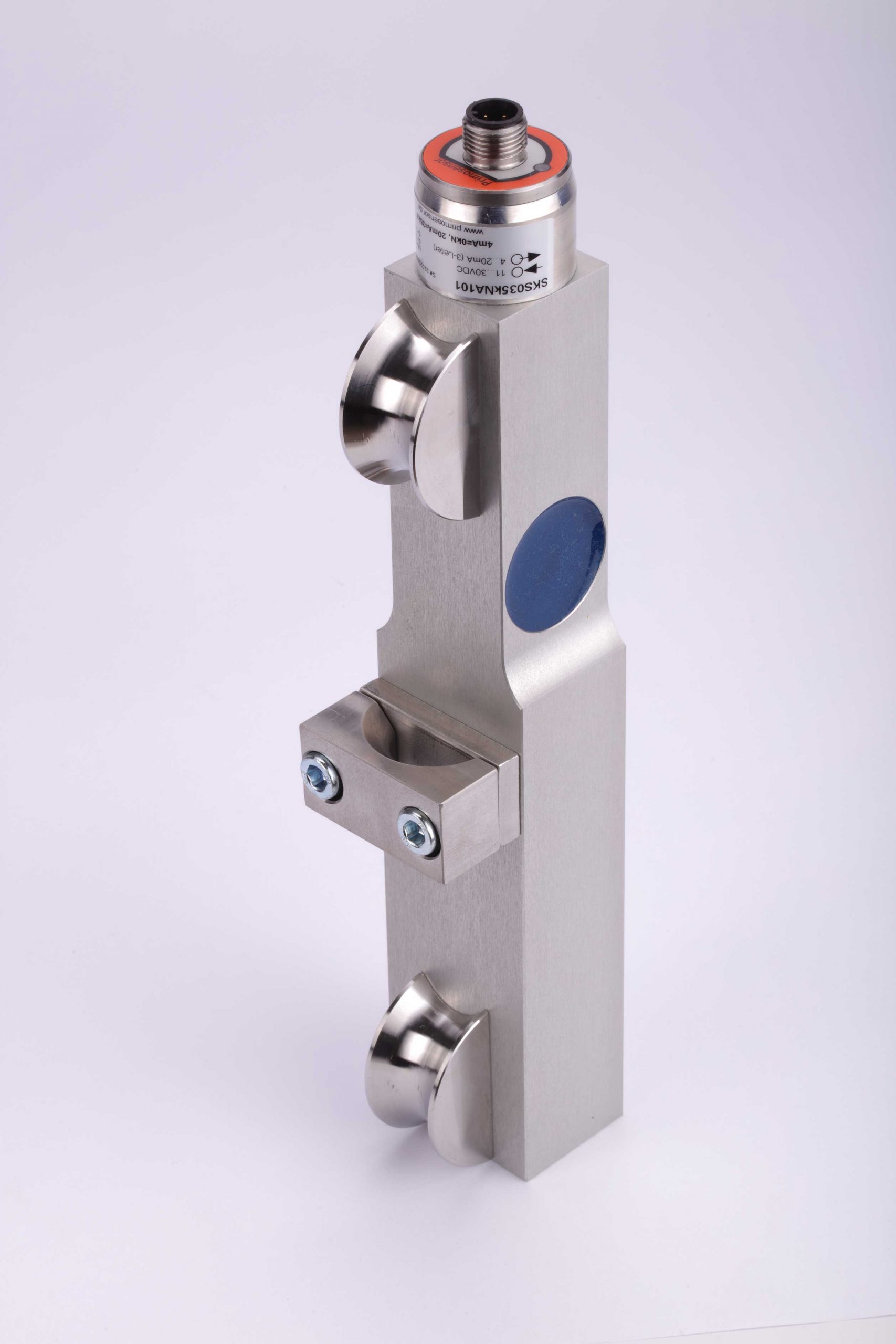 The cable force sensor is suitable both for continuously monitoring loads and for reliably detecting over- and underloads. When used in conjunction with Primosensor display units and our limit switches, the load can either be visualized or, if necessary, a shutdown can be triggered directly. By the way: The DGS4116 digital limit switch, which was recently added to our product portfolio, is the ideal complement to our SKS cable force sensor.
Key technical specifications for the SKS cable force transducer at a glance:
- Rated loads of 10 kN, 20 kN, and 35 kN (other rated loads available upon request)
- Can be used for rope diameters ranging from 8 to 18 mm without any adjustments
- No other cable guides, pulleys, or clamps are required—resulting in minimal installation effort, fewer sources of error, and consequently lower costs and greater safety
- Includes an LED on the sensor to check whether the operating voltage is correct, ideal for troubleshooting
- Plug connection directly on the sensor (M12x1) for easy installation
- with a 4–20 mA output signal, available in 3-wire or 2-wire configurations
Further details can be found in the data sheet.