



The calibration of devices and systems is of crucial importance when it comes to the accuracy and reliability of measurements. This also applies to force transducers or force sensors. Especially when they are used in applications that are subject to specified standards, a corresponding calibration certificate is often also relevant.

Primosensor offers the creation of factory calibration certificates (ISO certificates) in various versions for Primosensor tension and compression force transducers and force measuring units. Calibration certificates for tensile and/or compressive forces and the load levels or nominal loads (Fnom) from 1 kN to 100 kN are available as standard. For higher forces on request.
As a reference, we use DaKKs-calibrated force sensors in our force standard measuring devices during calibration. This means that our factory calibration certificates guarantee traceability to “national standards”.
Increasing and decreasing tensile and/or compressive forces are continuously applied to the force sensors in the measuring device. The measured values determined are recorded in certain defined stages and the device to be calibrated is compared with the reference.
The Primosensor testing machines work with a measurement uncertainty of <5 x 10⁻³. The factory calibration certificates issued contain information on both the measurement uncertainty of our testing machine and the measurement uncertainty (“accuracy”) of the calibrated force transducer.
When carrying out the calibration, we are guided by the currently valid norms and standards for the calibration of force transducers. For example, DIN EN ISO/IEC 17025 as the globally valid standard for testing and calibration laboratories and ISO 376 and DKD-R 3-3.

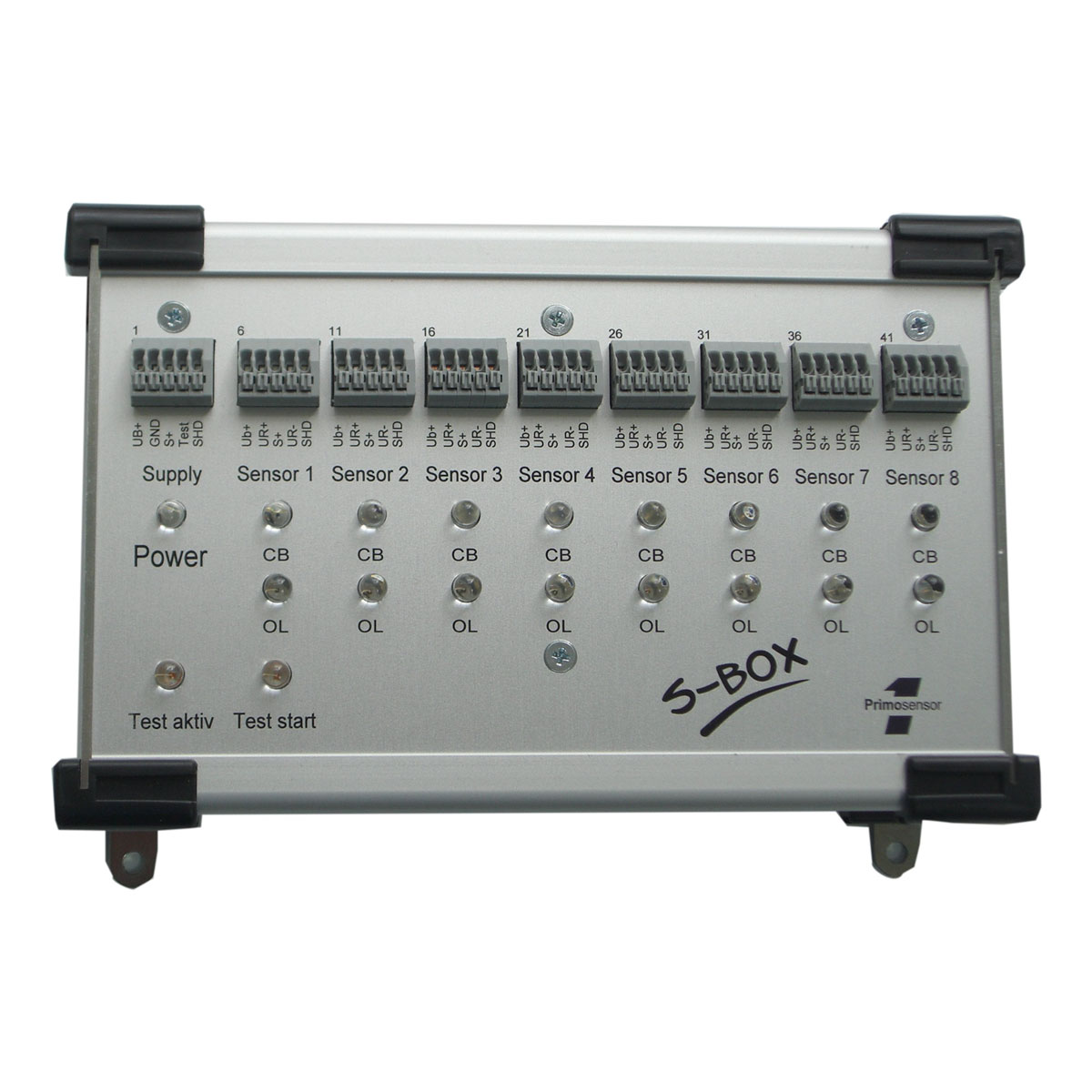
It is often useful to record and analyze multiple loads together. For example, the total load on a lifting platform with several lifting devices is of interest. Additionally, one might want to detect the overload of a single lifting unit and interrupt the lifting process accordingly. The Primosensor S-Box fulfills this task. It sums up to 8 analog signals and checks each individual signal for limit exceedances and cable breaks. The S-Box is suitable and certified for use with force transducers that provide a test signal.
We are currently renewing our certifications. The applications are being expanded to include 2-channel sensors.
Warum eigentlich eine Kalibrierung mit Prüfschein? Welche Gründe können zur Forderung nach einer Kalibrierung mit Prüfschein führen und was ist dabei zu beachten?
Dazu ist vorweg anzumerken, dass unsere Sensoren vor Auslieferung generell mehrere Justage- und Kalibrierzyklen durchlaufen und damit sichergestellt ist, dass sie den Angaben in unseren Datenblättern und/oder Zeichnungen entsprechen.
Reasons for an (additional) calibration certificate:

When should a recalibration be carried out?
The following tables show which versions of factory calibration certificates we offer as standard:
| Item number | Designation | Type of calibration | Number of measurement series | Calibration levels | Measurement series | Direction of force |
|---|---|---|---|---|---|---|
| DOK000PPL300 | Simple test report Delivery bill |
3
Points Test report
(printed on delivery bill) |
1 measurement series upwards | 50% | 0% / 50% / 100% | Compression force or Tensile force |
| DOK000PPL301 | Compression and Tensile force | |||||
| DOK000HPZ500 | Manufacturer's test certificate according to DIN 55350 Part 18 4.2.2 | 5 Points Test report | 1 measurement series upwards | 25% | 0% / 25% / 50% / 75% / 100% | Compression force or Tensile force |
| DOK000HPZ501 | Compression and Tensile force | |||||
| DOK000HPZ100 | 10 Points Test report | 1 measurement series upwards | 10% | 0% / 10% / 20% / 30% / 50% / 60% / 70% / 80% / 90% / 100% | Compression force or Tensile force | |
| DOK000HPZ101 | Compression and Tensile force |
| Item number | Designation | Type of calibration | Number of measurement series | Calibration levels | Measurement series | Direction of force |
|---|---|---|---|---|---|---|
| DOK000PPL310 | Simple test report Delivery bill |
3
Points Test report
(printed on delivery bill) |
1 measurement series upwards and downwards | 50% | 0% / 50% / 100% | Compression force or Tensile force |
| DOK000PPL311 | Compression and Tensile force | |||||
| DOK000HPZ510 | Manufacturer's test certificate according to DIN 55350 Part 18 4.2.2 | 5 Points Test report | 1 measurement series upwards and downwards | 25% | 0% / 25% / 50% / 75% / 100% | Compression force or Tensile force |
| DOK000HPZ511 | Compression and Tensile force | |||||
| DOK000HPZ110 | 10 Points Test report | 1 measurement series upwards and downwards | 10% | 0% / 10% / 20% / 30% / 50% / 60% / 70% / 80% / 90% / 100% | Compression force or Tensile force | |
| DOK000HPZ111 | Compression and Tensile force |
Design variants other than those listed here are available on request.

Call us or use the contact form. We will contact you.